Learn how AI automates data quality rule generation, profiling, and monitoring to replace manual validation at scale.
Table of Contents
Like this article?
Follow our monthly digest to get more educational content like this.

Data governance is the practice of defining standards across the organization to ensure that data is accurate and secure and can be used consistently. It typically covers areas such as data ownership, quality, metadata, and how data is managed throughout its lifecycle. As organizations increasingly rely on data for decision-making and business operations, effective data governance has become increasingly important to maintain data quality and accuracy. This ensures that data remains trustworthy across different systems, while also supporting regulatory and compliance requirements.
Traditional governance processes often struggle to keep pace with today’s data pipelines, where there are continuously new data sources to integrate and existing ones that need to be maintained. For each source, it typically requires manually documenting business definitions, classifying data sensitivity, assigning ownership, creating data quality rules, and creating the metadata. These manual tasks become increasingly time-consuming as the number of data assets continues to grow.
AI-powered data governance is a technology that uses artificial intelligence to automate and continuously improve how organizations manage their data by analyzing the patterns and behavior of the data. It can alleviate the challenges described above by automating activities such as metadata generation, classification, and data quality checks. It can also help maintain existing data assets as it can continuously scan for changes and provide recommendations. This allows organizations to maintain high-quality governance with less effort.
This article highlights six best practices for incorporating AI into your data governance strategy while maintaining accuracy and accountability.
Summary of AI-powered data governance best practices
Capture business definitions before automating governance
While AI can infer meaning from table names, column names, and data values, this information can be ambiguous and may lead to incorrect recommendations that do not align to your organization’s data standards. To avoid these situations, it is important for organizations to document key business definitions before introducing AI-powered governance.
The important business context that needs to be defined may include business glossaries, data ownership of various types of data, business rules that define how data should be used, and data sensitivity classification. This information helps your AI-augmented governance tools generate more accurate metadata and recommendations for access control, data quality checks, and so on.
For example, consider a sales data store containing customer orders. If the business context defines an organizational policy specifying that columns of type address should be considered confidential, an AI-powered system can understand that the “Shipping Address” column contains sensitive customer information and classify it as such. It can then recommend field masking and restrict access to this column only to the data owners.
Centralize rules across business and technical teams
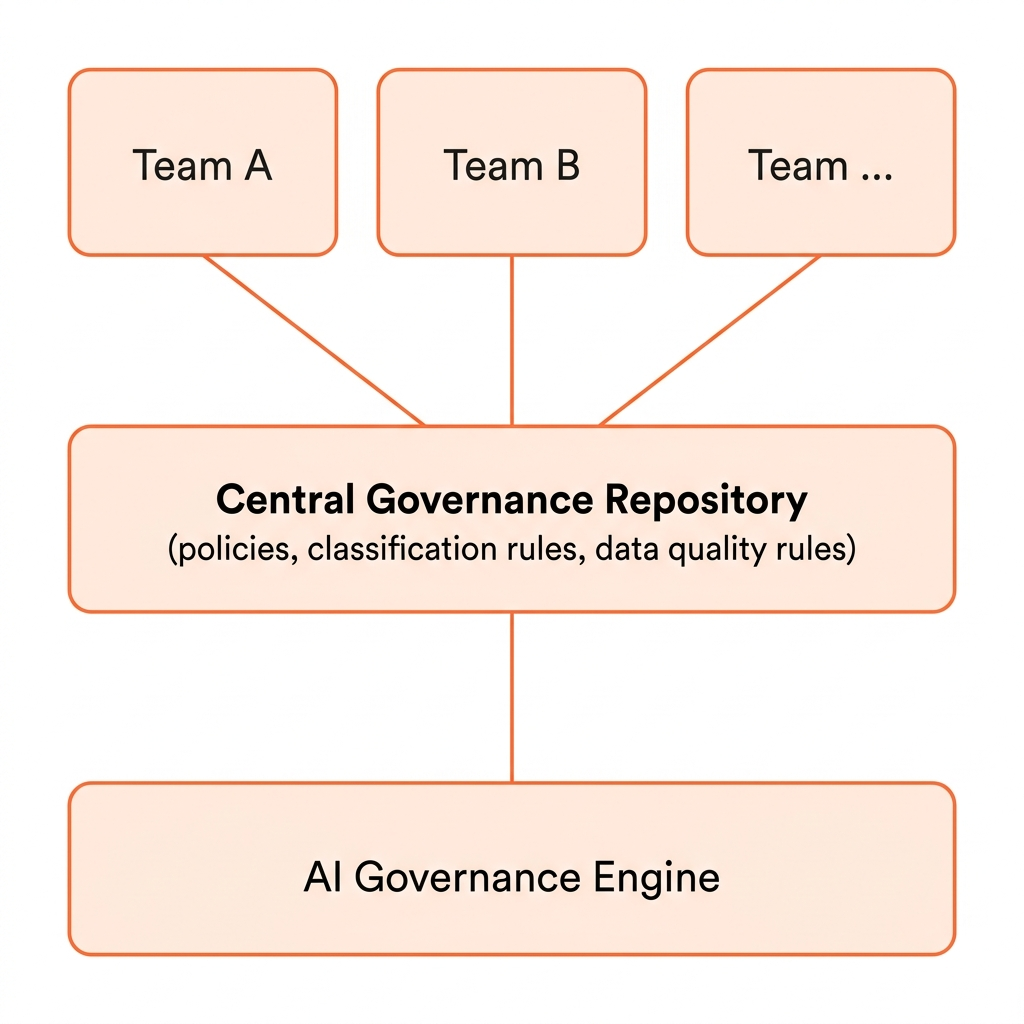
Since AI-powered governance is only as reliable as the rules that it infers from, it is important to have a single source of truth across your organization for these rules. If governance information is scattered across file documents, source code, and various data systems, business and technical teams may work with different versions of data rules. This results in inconsistent AI tool recommendations that depend on which source is being referenced.
For example, a data engineering team may label a customer dataset as “internal” to indicate that it can be used by other teams within the organization. However, the compliance team might classify customer data as “confidential” because it contains personally identifiable information (PII). Without a centralized governance repository, AI may provide conflicting recommendations on classification and access policies.
As such, prior to incorporating AI-augmented data governance, organizations should establish a single repository for governance information that the AI tools can refer to. This repository should centralize data policies, classification and tagging rules, and data quality rules. It should also store information related to the ownership and the versioning log of the rules so that historical changes can be traced easily. Finally, to ensure that both technical and business teams can efficiently collaborate and align on the policies, the repository should also be able to be easily used by both types of users.
Use AI profiling to surface governance gaps
Traditional data governance often relies on periodic manual reviews to identify governance issues. As such, problems may stay undetected for weeks or even months, and it may take longer to remediate them.
With AI-powered profiling, data assets and metadata can be continuously analyzed, which allows governance gaps to be identified earlier. This profiling can examine characteristics of your data, such as null values, data distributions, value patterns, and unusual changes in these profiles. The types of governance issues that can be detected by AI can range from identifying missing data owners, incomplete catalog metadata, and gaps in data quality monitoring, where some datasets or fields are not being checked against your defined quality standards. This reduces the impact on downstream analytics, AI applications, and regulatory compliance.
In addition to automated detection, you can also leverage AI tools to automate the remediation process. Based on the governance policies that your organization has defined, they can classify datasets, suggest the appropriate access control, and generate new data quality rules to improve coverage. For example, modern data quality platforms such as Qualytics can automatically generate up to 95% of data quality rules, which significantly reduces the manual effort required when managing large amounts of data assets.
[Qualytics slide about 95% automated generation for data quality checks]
{{banner-large-1="/banners"}}
Build governance enforcement into AI workflows
As your organization incorporates AI into your data governance workflows, the AI systems will propose various governance assets, such as documentation, metadata, data quality rules, access policies, and so on. Even though this can accelerate the integration of new data sources, your teams should treat these generated assets similarly to application code, where there should be validations and human approval in place before deployment to the live environment.
These validation checks should verify that the AI-generated assets comply with your organization’s standards and that they will not negatively impact downstream applications. For example, incorrect data quality rules can block healthy data from being processed. An AI profiling that automatically defines “Revenue >= 0” will fail many records if your dataset also records negative values like refunds on the Revenue column. This may break your ETL pipeline, or worse, lead to silently ignoring the records and causing financial dashboards to show the wrong insight.
Therefore, it is important to look for AI-augmented platforms that support draft workflows and dry runs so that issues in the AI-generated assets can be detected and resolved before deployment. During a dry run, the AI-recommended data quality rules can be run against historical data. If there are too many false positives or an abnormal number of positives, the deployment should be blocked until further review.
Maintain attribution for every rule change and resolution
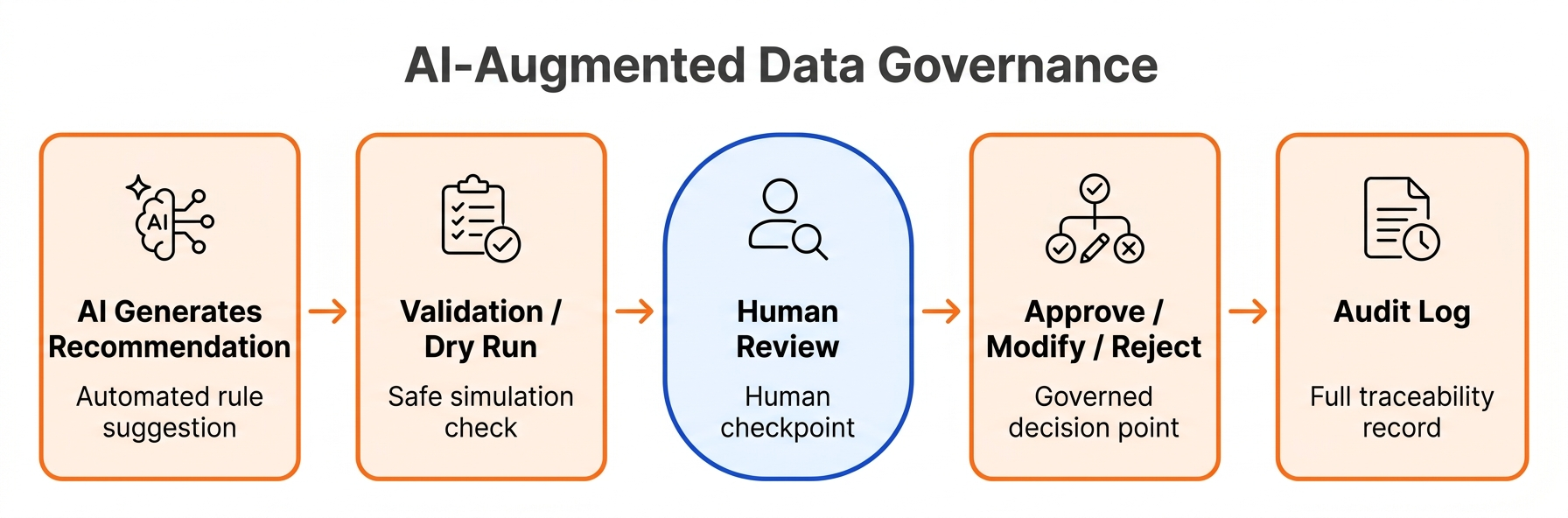
Governance decisions often require business context and accountability from data owners or stewards, which means that AI should only act as an assistant, not a final decision maker. While automated technical validations and dry runs can be used to check the AI-generated assets before deployment, it is also necessary to incorporate human oversight when making any changes to the live environment.
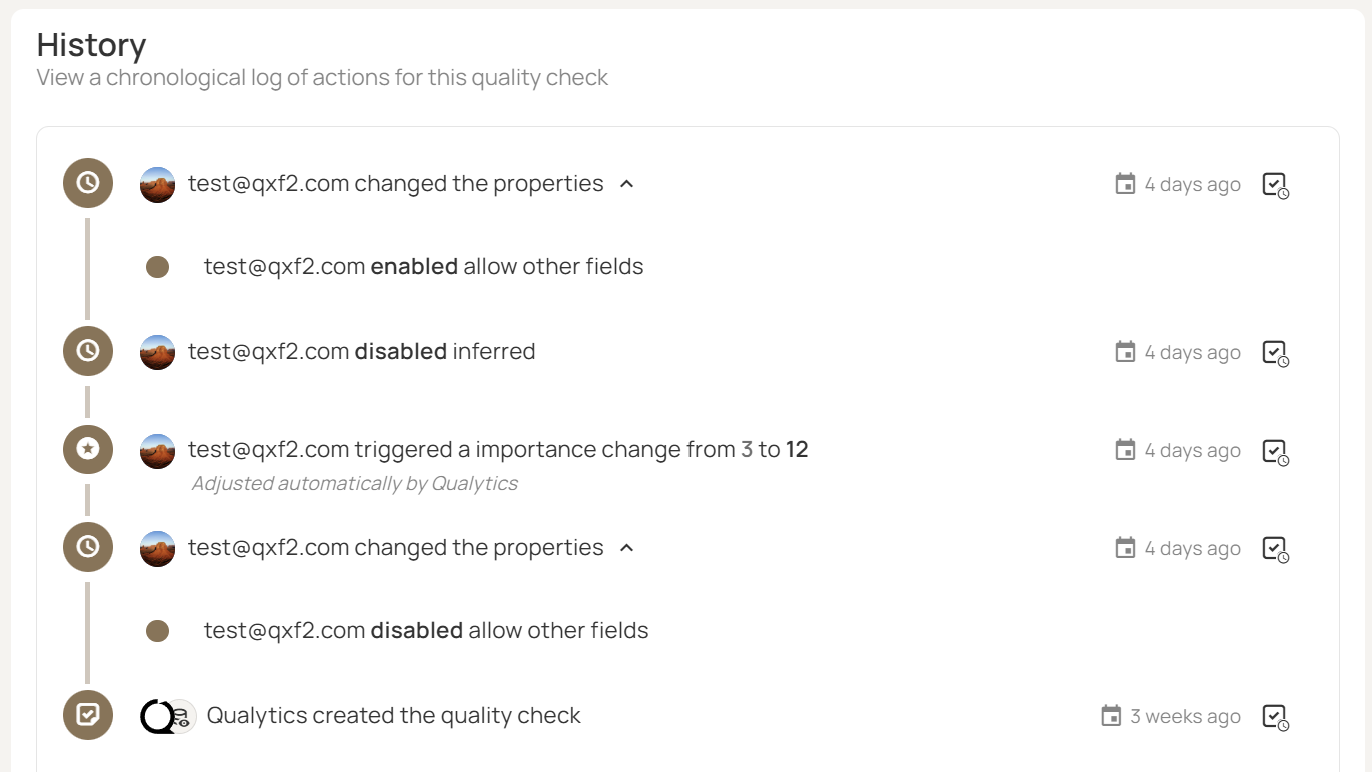
A typical governance workflow starts with AI generating a recommendation, followed by review by the data owner or steward. The reviewer can approve, modify, or reject the proposed change before it is applied. These decisions should then be recorded in an audit log, creating a detailed history of who reviewed the recommendation, what decision was made, any modifications added, and when the change was applied. This audit trail simplifies compliance audits and provides transparency into how the policies evolve over time and the people who were responsible.
Qualytics, a modern data quality platform, provides features to support this AI-augmented workflow that keeps humans in the approval process. This ensures that your teams stay fully in charge and governance changes remain traceable. The screenshot below shows an example of the history log on Qualytics—you can also expand each activity to see the detailed state at that time.
Extend governance to AI agents and copilots
As AI agents and copilots become integrated into business processes, they should be governed just like human users and other data applications. Instead of giving them unrestricted access to all of your organization’s data, you should define the specific function of each agent, which datasets it can access, and the scope of the data. The authorization system of the AI agents and copilots should also be configured to respect the permission level of the end user that they are assisting.
For example, a sales copilot may retrieve data related to customer orders and sales metrics to answer business questions, but it should not have access to confidential HR data. It should also only return information that the requesting user is authorized to access. As an example, the product team may have the privilege to see sales revenue for their products, but they should not be able to inquire about customers’ billing addresses.
On top of access control, your organization should also monitor AI agent activities by recording access logs and detecting unusual behavior. AI agents that repeatedly access sensitive data, attempt to access data outside of their assigned domain, or show unexpected spikes in data retrieval may indicate misuse or other security issues.
{{banner-small-1="/banners"}}
Conclusion
AI-powered governance enables organizations to make governance more scalable and efficient by automating some tasks, such as metadata generation, classification, and data quality management. However, it should only serve as an assistant, with any governance changes authorized by the responsible data owner or stewards.
When evaluating a data governance or data quality platform, organizations should not only look for its AI capabilities but also the surrounding governance controls, such as approval workflows, dry runs, and a transparent audit log. A platform like Qualytics combines AI-powered automation with these governance features, helping organizations improve their data governance while maintaining control and accountability.
Chapters
AI for Data Quality: A Practical Guide to Automated Monitoring at Scale
Learn how AI automates data quality rule generation, profiling, and monitoring to replace manual validation at scale.
AI-Powered Data Governance Best Practices: Automate, Govern, and Stay Accountable
Learn how AI transforms data governance from a manual burden into a scalable, intelligent, automated system.