Hear how Georgia-Pacific's data management leader brought business users into data quality and made it everyone's job.

Jul 30, 2026
6
min read
Table of Contents

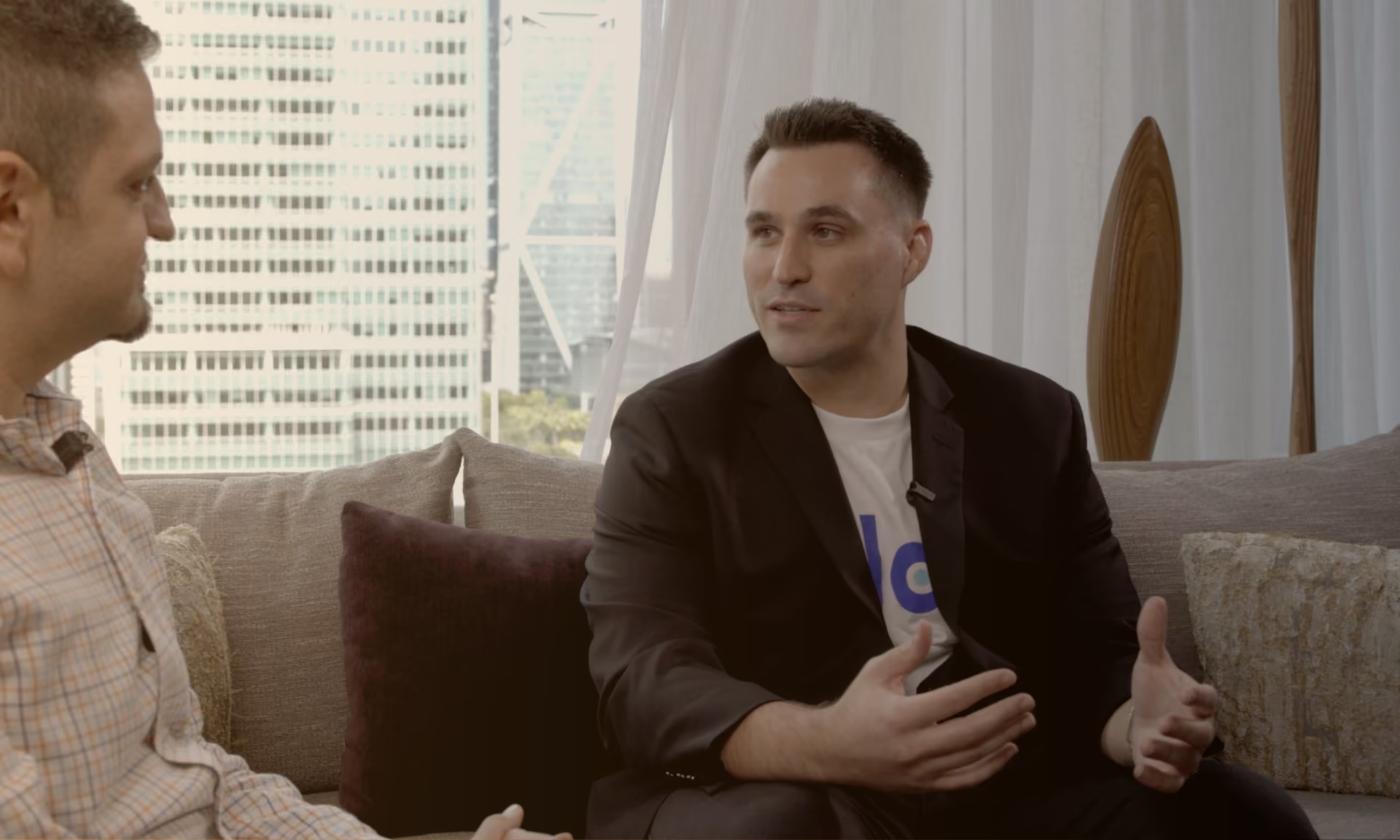
Plenty of data teams have the platform, the pipelines, and the catalog in good order and still get blindsided by data that turns out to be wrong. The infrastructure that moves data doesn’t check whether the data is correct or fit for purpose, and that gap is easy to miss until something built on it breaks. Yannique Kameka, Senior Director of Data Management at Georgia-Pacific, sat down with our co-founder and CEO, Gorkem Sevinc, to talk about what it takes to close that gap.
Their conversation covered the difference between a healthy pipeline and trustworthy data, the discovery that put a financial number on a data quality problem, how Georgia-Pacific pushes data quality ownership out to the business, and how the team is feeding quality signals to AI agents so they know when to act and when to stop.
Here's what we learned from their conversation:
1. A strong foundation still leaves a gap
Yannique inherited a good setup. Georgia-Pacific had already invested in a centralized platform with reliable pipelines and had started expanding its cataloging, so most of the foundation was in place. "It was in a pretty decent place, except for data quality," she said. Her team knew where the data lived and how it moved, but they couldn’t always answer whether it was fit to use.
She explains the gap with a plumbing analogy:
"Our data pipelines help us understand that there's water flowing through those pipes, it's at the right pressure level, you don't have any leaks. But you don't know when you turn the faucet on, is that water going to be clear or brown, is it drinkable, is it safe, is it fit for purpose for what you're going to try to do with it in the business?"
Closing that gap fell to a small data quality team within Georgia-Pacific, focused on high-priority areas like finance, and it had become a bottleneck. They took in requests, built rules, and moved on, and they couldn’t keep up with the growing needs of the business.
"We were at a crossroads. We were either going to scale up this team, which is a heavy engineering focus, or find a tool or a path that's going to help us push that data quality responsibility down to the business and scale out instead of expanding our team."
They chose the second path with Qualytics.
2. The finding that put a number on a data problem
In the first two weeks with Qualytics, a data analytics partner at Georgia-Pacific flagged a recurring pain point in a dataset their team relied on and couldn’t pin down its cause. They were spending significant time manually fixing it before anything reached a dashboard.
Georgia-Pacific pointed Qualytics at the source, ran the analysis, and within hours found that 16% of its class-code data was incorrectly assigned.
"16%, it's not huge, but it's big enough to make me care."
Those class codes drive accounting decisions downstream, so when the team layered financial analysis onto that finding, the conversation changed.
"It's no longer just a data nuisance or something the analytics team has to clean up and manually patch downstream. It became something we needed to fix upstream. We need to go to the source, figure out what's going on, and put the guardrails in place."
Detection was the fast part. Getting the business to act meant connecting the finding to a consequence a leader already cared about.
"You've got to make the impact real. It was socializing it until somebody connected the dots to say there's financial impact here. Then you put those numbers in front of people, and they realize if I don't change this, it's going to have detrimental impact to the company."
The finding also changed the question people were asking. Instead of debating one dataset, people started asking how much data had never been examined in this way: "How many other data issues do we have sitting out there in our source systems?"
3. Pushing data quality out to the people who own the data
The shift Yannique keeps returning to now is ownership. Data quality at Georgia-Pacific is no longer the job of a single governance or data quality team.
"We say it all the time: data quality is everyone's responsibility. Everyone has a play in this."
In practice, that means business teams building and reviewing their own checks against their own data, with the data quality function moving closer to the people who manage it day to day.
"Now that we're pointing [Qualytics] at their live production data, the data is telling the story for us. They're seeing it, and it clicks right away."
Getting there is not uniform across every business unit. "All the socialization and the excitement building was the easy part. Now everybody wants in, and everybody wants to do it their way," Yannique says. Each business unit sits at a different point in its data journey with different skills on the team. Some are more confident they know their data and can build their own rules; others need more help and guidance.
"It's not about teaching one person, it's teaching the whole business because we’re changing the mental model of making everyone care about data quality, not just the data governance team or data quality teams."
4. Giving AI the signals to know when to act
Data quality used to be a back-end concern: something broke, someone added a rule so it wouldn't break again. AI changed that. "AI is only as good as the data that you feed it," Yannique says, which is why data quality is now a prerequisite for every AI and analytics use case the business wants to stand up.
Doing that in practice means exposing quality signals to the systems that consume the data. Georgia-Pacific is surfacing confidence scores to its agents so an agent can decide how to proceed rather than acting blindly.
"If an agent sees that a check has failed somewhere, the agent can make the decision: do I stop and flag this for a human in the loop to review, or do I fall back to a more trusted data source in my workflow?"
The agent is handed a signal and a choice instead of being trusted to run on unvalidated data. And the bar moves with the stakes: "A financial or accounting decision requires a higher confidence score than a marketing use case. Marketing is going to be more flexible with the variances."
Gorkem framed the mechanism as combining an LLM's reasoning with governed metadata and quality signals, delivered at the point of use. Past anomalies, failed checks, and resolution history become the context an agent reasons over before it acts. That is validate-at-use in practice.
The same signals lowered the barrier for people, too. Qualytics’ AgentQ changed how Georgia-Pacific's non-technical users engage, letting them ask a question in plain language and get back an explanation of what a result means and what to consider next. "They're using it to build their checks, they're using it to decipher those checks, to analyze the results. It's pretty awesome, it's a game changer," Yannique says.
Data quality is everyone's job
One thread runs through the whole conversation: data quality stopped being one team's problem. It shifted the moment the class-code finding carried financial impact and the people who owned that data could act on it. Detection was never the constraint. Making the finding matter to the business, and putting it in the hands of the people who could fix it at the source, changed how Georgia-Pacific operates.
Yannique's question to her own organization is worth borrowing: how many data issues are sitting in your source systems right now, and when your AI reaches them, will it know to stop?
Chapters
Related Articles
Atlan's Austin Kronz: "Context is the One Thing AI Can't Commoditize"
Atlan's data & AI strategy leader explains why context is the differentiation AI can't commoditize, and why it decays without a dedicated lifecycle.

CEO Gorkem Sevinc on Data Quality, Ownership, and AI Governance
Qualytics CEO discusses why data quality is a business problem, and why AI needs human oversight.

How to Make the Business Case for Data Quality (Without Talking About Data Quality)
Learn how data leaders frame data quality as a business enabler by using AI, risk, and operations stories executives understand to justify investment and accelerate outcomes.
Related News
Atlan's Austin Kronz: "Context is the One Thing AI Can't Commoditize"
Atlan's data & AI strategy leader explains why context is the differentiation AI can't commoditize, and why it decays without a dedicated lifecycle.
CEO Gorkem Sevinc on Data Quality, Ownership, and AI Governance
Qualytics CEO discusses why data quality is a business problem, and why AI needs human oversight.
How to Make the Business Case for Data Quality (Without Talking About Data Quality)
Learn how data leaders frame data quality as a business enabler by using AI, risk, and operations stories executives understand to justify investment and accelerate outcomes.