AI can't govern what it doesn't understand.Humans can't scale without AI that does.
What counts as "good" data depends on business context that no system captures on its own. Qualytics brings that context into a shared, governed foundation that serves business teams, data teams, and AI systems equally.
Why build for humans and AI?
Business logic, domain expertise, and institutional knowledge about data live across teams in organizational memory: in the heads of SMEs, in undocumented exceptions, in business rules that shift as requirements change. Data catalogs capture part of this through business definitions, metadata, and lineage. But definitions without quality signals are incomplete, and quality signals without business context are hard to trust. Qualytics closes that gap.
Governed Organizational Memory
Organizational memory is where most business knowledge about data lives: the undocumented exceptions, informal rules, and institutional context that only certain people carry. When teams document exceptions, resolve anomalies, or refine business rules in Qualytics, that knowledge becomes governed context that persists, evolves, and serves both humans and AI systems.
Business logic documented and maintained alongside quality rules
Exception handling captured with full resolution context
Business rules versioned and auditable as requirements evolve
Institutional knowledge preserved and explainable, independent of team turnover
Connected Context Layer
Data catalogs provide essential context: business definitions, metadata, and lineage, but that context is incomplete without quality signals. Qualytics extends that context with real-time quality signals, connecting what data means with whether it can be trusted.
Integration with existing data catalogs to enrich business definitions with quality signals
Quality scores and anomaly context available alongside catalog metadata
Business definitions connected to active rules and validation outcomes
Lineage context enriched with data quality status at each stage
Shared Ground Truth
Business and data teams share visibility into rules, workflows, and outcomes without needing to translate between business requirements and technical implementation. One view of what's being enforced, what's failing, and what's been resolved.
Shared dashboards across business and technical stakeholders
Quality scores at field, container, and datastore levels
Anomaly trends and resolution history accessible to all teams
No translation layer between business meaning and technical enforcement
From Human Knowledge to AI Context
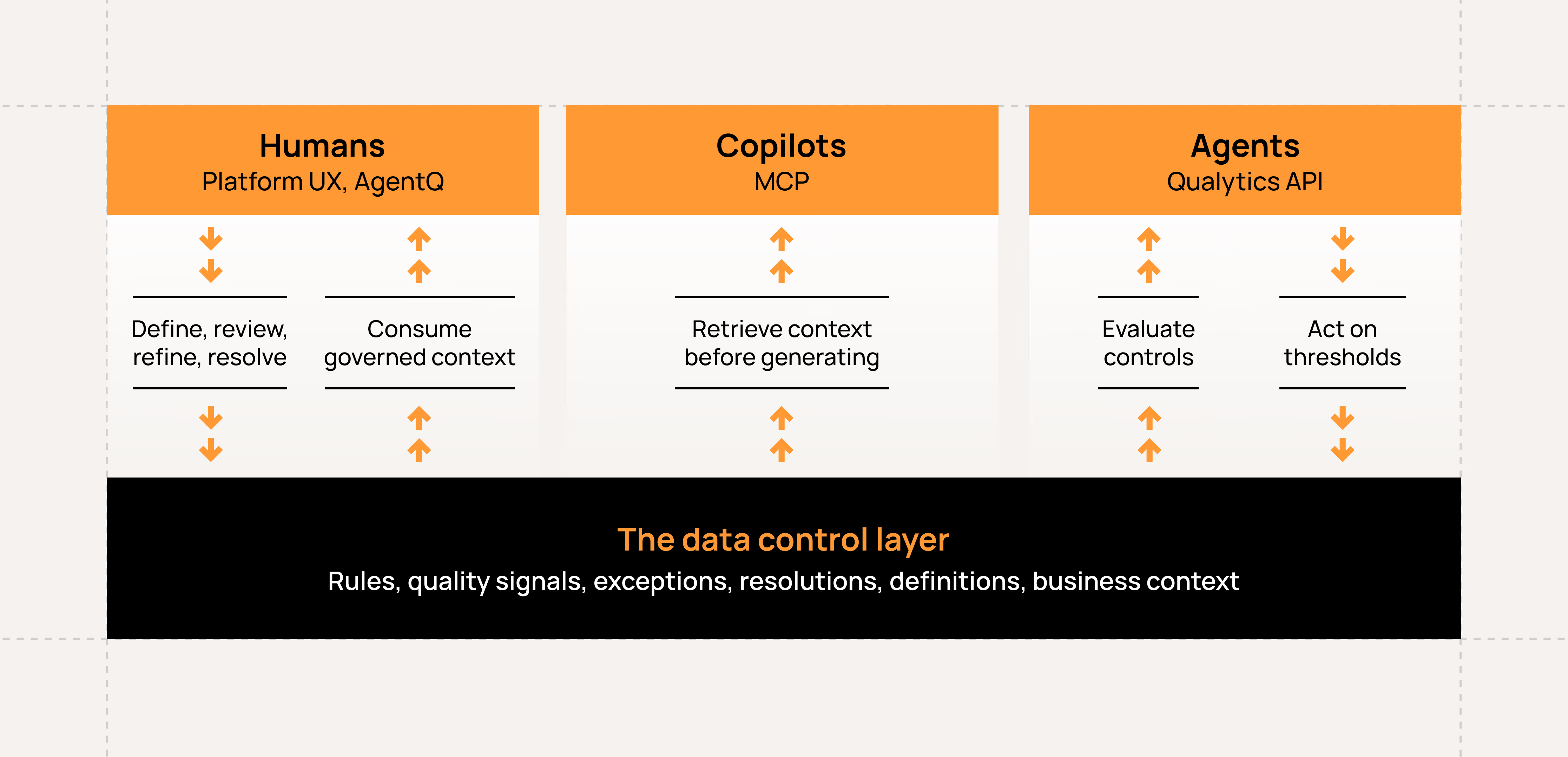
Copilots and agents access the same governed context as human users, with no separate infrastructure required. The business logic, quality rules, exceptions, and resolution history that teams build over time are the same context AI systems operate on.
Copilots and agents access the same rules, exceptions, past resolutions, and definitions as humans
No separate data quality infrastructure for AI consumption
Governed context available through MCP for copilots and the Qualytics API for agents
AI systems inherit the same business logic and governance that human teams define
See how trusted signals reach copilots and agents
The Results
Why enterprises choose Qualytics for data quality
50+
business users resolving anomalies alongside data teams
4x
faster remediation through cross-team collaboration
4
interaction models on one governed foundation (platform UI, AgentQ, MCP, API)
Hear from Our Customers
Frequently Asked Questions
Qualytics supports any SQL datastore and raw files on object storage. This includes modern platforms like Snowflake, Databricks, BigQuery, and Redshift, relational databases like MySQL, PostgreSQL, and Microsoft SQL Server, and file formats like CSV, XLSX, and JSON on AWS S3, Google Cloud Storage, and Azure Data Lake Storage. Qualytics also integrates with streaming data sources through our API.
Qualytics is built on Apache Spark and deployed via Kubernetes, with vertical and horizontal scalability designed for enterprise volumes. Customers run tens of thousands of rules across billions of rows across SaaS, on-prem, and hybrid environments.
Every rule definition, anomaly resolution, documented exception, and business logic update is captured as governed context within Qualytics. This context persists, evolves over time, and is accessible to both human users and AI systems operating on the same foundation.
Copilots and agents operate on the same governed foundation as human users. They access the same rules, exceptions, past resolutions, and definitions without requiring separate infrastructure or parallel workflows. The details of how they connect are covered on our Trusted Signals page.
New data sources can be onboarded in minutes. Automated rule inference delivers broad coverage from day one. Customers like MAPFRE USA gained thousands of inferred rules in a single day, coverage that would have taken months of engineering effort to build manually.
Yes. Qualytics provides a single governed foundation where business SMEs and data teams share visibility into rules, workflows, and outcomes. Business users don't need technical skills to participate — the platform is built with low-code interfaces and natural language through AgentQ.
No. Raw data is pulled into memory for analysis and subsequently destroyed. Anomalies and metadata are written to an enrichment datastore maintained by the customer. Highly regulated industries can deploy Qualytics within their own network where raw data never leaves their environment.
Qualytics has bidirectional integrations with Atlan, Alation, Collibra, Datahub, and Unity Catalog. Qualytics reads business definitions, metadata, and lineage from your catalog, and pushes quality scores and anomaly context back in. This connects what data means with whether it can be trusted, directly inside the tools your teams already use.

Ready to take control of your data quality?