Insurance companies use Qualytics to operationalize proactive data quality to protect premiums, underwriting, claims, and regulatory reporting—preventing amplifying hidden data issues into financial and compliance risk.

Feb 3, 2026
6
min read
Table of Contents
See how Qualytics helps insurance companies reduce regulatory and business risk.

In insurance, the same data is reused everywhere. Policy, exposure, claims, and third-party data all flow through underwriting, pricing, claims automation, actuarial models, finance, regulatory reporting, and increasingly, AI-driven decisioning. When that data is unreliable, the impact shows up as premium leakage, mispriced risk, reserve volatility, audit findings, and regulatory scrutiny.
The problem is that controls continue operating on incomplete, inconsistent, or stale data long before anyone notices. Traditional data quality approaches surface issues downstream, showing up on dashboards, post-hoc monitoring, or reconciliations late in the cycle. By then, automated processes and AI systems may have already amplified small data defects into material business and regulatory risk.
Insurers use Qualytics to enforce data quality upstream, validating data continuously before it reaches underwriting decisions, claims workflows, regulatory reporting, or AI systems. Below are the nine most common ways insurance organizations operationalize data quality with Qualytics.
Ensuring Policyholder and Insured Identity Integrity
Identity data sits at the core of insurance controls. Exposure aggregation, fraud detection, underwriting eligibility, and regulatory reporting all depend on accurate linkage between policyholders, insureds, claimants, beneficiaries, and related entities.
In practice, this data is fragmented across onboarding, underwriting, policy administration, claims, billing, and finance systems. Duplicate records, missing identifiers, inconsistent classifications, and broken relationships are common. When controls operate on misaligned identity data, insurers underestimate exposure, weaken fraud and conduct controls, and introduce regulatory risk even when downstream checks appear to be functioning.
Insurance companies use Qualytics to continuously validate policyholder and insured identity data across systems of record. Entity resolution checks link fragmented identities, existence and completeness checks ensure all required parties are present, and cross-record consistency checks validate alignment between policies, coverages, and insured entities.
Teams also track identity quality metrics like duplication rates, unresolved entities, and hierarchy drift over time. This prevents automation and AI-driven underwriting or claims processes from scaling fragmented identities into systemic exposure and compliance failures.
Protecting Premium Integrity and Preventing Leakage
Premium leakage rarely comes from one obvious error. It accumulates through small data issues: missing endorsements, misclassified coverages, inconsistent exposure values, or breaks between systems.
Traditional controls often detect these issues after premiums are billed or reported, when remediation is costly and sometimes impossible. Insurers use Qualytics to validate premium, exposure, and policy data before it is consumed by pricing analytics, billing, and financial reporting.
Cross-system reconciliation checks align written, billed, and earned premium, while completeness and consistency rules ensure required coverages and attributes are present and correctly classified.
One global insurer identified approximately $10M per year in premium leakage tied directly to data quality issues. By replacing periodic, manual checks with continuous validation using Qualytics, the organization surfaced issues much earlier and significantly reduced financial leakage and downstream remediation.
By catching issues upstream, insurers protect profitability and pricing accuracy without adding operational overhead.
Validating Underwriting Data Before Automation Scales Errors
Modern underwriting increasingly relies on automation and AI-assisted decisioning. These systems assume that risk, exposure, and eligibility data is complete, current, and aligned with underwriting rules.
In reality, underwriting data drifts when third-party risk inputs change, new fields appear, or definitions evolve. When models continue running on outdated or misaligned data, errors are scaled quickly across large volumes of quotes and bound policies.
Insurers use Qualytics to validate underwriting inputs before quotes are generated or policies are bound. Completeness checks ensure required disclosures and eligibility attributes are populated, while cross-field consistency rules validate alignment between risk characteristics, coverage selections, limits, and pricing variables.
MAPFRE uses Qualytics to validate underwriting and policy data continuously before it reaches automated decisioning and reporting workflows. This allows underwriting teams to scale automation with greater confidence, knowing that eligibility, exposure, and coverage data is being checked upstream rather than corrected after policies are bound.
Proactive validation prevents automation and AI from turning incomplete underwriting data into systemic mispricing or unintended portfolio risk.
Ensuring Claims Data Integrity for Analytics and Automation
Claims data is dynamic and sourced from multiple systems. Missing attributes, misclassified loss causes, or inconsistent claim statuses undermine claims analytics, reserving processes, and automated workflows.
When these issues aren’t detected early, they surface during reserving cycles, financial close, or regulatory reporting and drive rework, reserve volatility, and adjustment risk. Automated systems often continue operating, masking underlying data problems until they affect reported results.
Insurers use Qualytics to continuously validate claims and transaction data before it feeds analytics so they can preserve processes and AI-assisted claims workflows. Domain and validity checks enforce correct classifications, while reconciliation and aggregation comparison checks align claims activity across claims, actuarial, and finance systems.
By validating claims data on a continuous basis, insurers improve confidence in loss ratios and reserve estimates while reducing late-cycle corrections and regulatory scrutiny. Early validation prevents partial or misclassified claims data from being amplified into distorted reserving outcomes.
Validating Third-Party Data Before It Propagates
Third-party data concentrates risk at the source. The same catastrophe models, hazard data, property data, or credit feeds are reused across underwriting, pricing, reserving, capital modeling, and regulatory disclosures. That means late deliveries, partial populations, schema changes, or definition drift weaken multiple downstream controls at once.
Insurers use Qualytics to validate third-party data at ingestion using freshness, volume, and completeness checks. Schema drift detection flags structural changes, while time-series metrics detect abnormal distribution shifts before data is consumed.
By catching issues at the source, insurers prevent a single vendor defect from cascading across pricing, reserving, and regulatory pipelines, which significantly reduces late-cycle surprises tied to external data quality.
Reconciling Reinsurance Reporting and Recoverables
Reinsurance reporting depends on accurate aggregation of policies, exposures, claims, and treaty terms across underwriting, claims, actuarial, and finance systems. Even small data breaks can lead to disputed recoverables, delayed settlements, and audit findings.
Insurers use Qualytics to automate reinsurance reconciliations, validating ceded premiums, losses, and recoverables across systems. Aggregation comparison checks ensure treaty-level rollups align and completeness checks confirm all in-scope policies and claims are included.
Additionally, time-series monitoring highlights unexpected shifts in ceded loss development or recoverable balances. Automated, explainable reconciliation upstream improves recovery outcomes while reducing operational, financial, and audit risk.
Validating Inputs to Regulatory and Actuarial Controls
Statutory reporting, solvency calculations, and IFRS 17 controls rely on data aggregated across policy, claims, actuarial, and finance systems. Even correct calculations can produce incorrect results if input data is incomplete or misaligned.
Insurers use Qualytics to validate population completeness, consistency, and aggregation integrity before regulatory and actuarial processing begins. Reconciliation checks align source data with actuarial extracts and reporting outputs, while schema drift detection surfaces changes that could invalidate regulatory pipelines.
These controls run prior to reporting cycles, strengthening confidence in filings and reducing late-cycle remediation and supervisory findings. Strong models cannot compensate for weak input data.
Producing Audit-Ready Evidence of Data Controls
Data quality controls likely already exist, but evidence is often fragmented across scripts, logs, and spreadsheets. During audits or regulatory exams, teams scramble to reconstruct proof of execution and remediation.
Qualytics retains traceable evidence of data quality control execution — including results, failed records, approvals, and remediation history. Reconciliation exceptions are explainable, and time-series views demonstrate control effectiveness over time.
Insurers using Qualytics report lower audit friction, with evidence readily available rather than rebuilt retroactively. Audit readiness becomes a byproduct of daily operations, not a last-minute scramble.
Enabling Shared Ownership Between Business and Data Teams
In many insurers, data quality accountability sits almost entirely with technical teams, even when business teams own underwriting, claims, and financial outcomes. This creates bottlenecks, slows remediation, and misaligns priorities.
Insurers use Qualytics to operationalize shared ownership of data quality across underwriting, claims, actuarial, finance, and data teams without sacrificing centralized governance or consistency. Business users contribute domain context by defining and refining data quality checks, while data teams maintain scalable control frameworks.
With Qualytics, MAPFRE USA’s business users actively co-author and refine data quality rules, reducing dependency on engineering teams and accelerating remediation cycles. By automating rule inference and validation, MAPFRE saved roughly 3,000 engineering hours and approximately $442,500 in data quality efficiency costs.
Shared ownership improves coverage, speeds resolution, and ensures data quality controls reflect real insurance risk, not just technical validity.
Insurers Use Qualytics to Enforce Trust at Scale
Across insurance, the pattern is consistent. Data quality failures don’t announce themselves. They quietly weaken controls while automation and AI continue operating as if nothing has changed.
Insurers use Qualytics to enforce trust before data is used for underwriting, claims automation, regulatory reporting, or AI-driven decisioning. As data reuse and decision velocity accelerate, proactive data quality has become a core insurance control — not a technical afterthought.
Book a demo to see how leading insurers operationalize data quality across their most critical use cases.
Chapters
Related Articles

Preparing Data for AI in Financial Institutions: A Practical Playbook for De-Risking Data Quality
Financial institutions can't scale AI, risk operations, or regulatory reporting without trusted data. Here’s how to reduce operational risk, increase regulatory confidence, and accelerate AI-readiness.
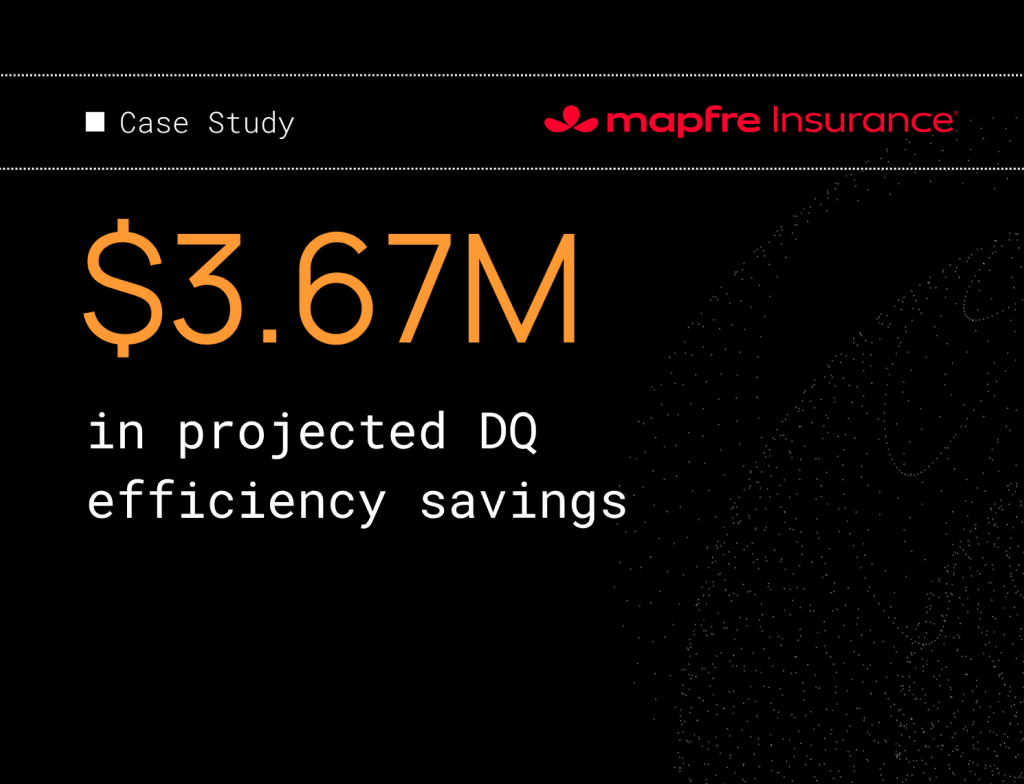
Catching Hidden Data Quality Errors Before They Cost Millions: MAPFRE USA + Qualytics
Shifted from reactive cleanup to proactive controls, preventing costly downstream data errors.
Related News
Preparing Data for AI in Financial Institutions: A Practical Playbook for De-Risking Data Quality
Financial institutions can't scale AI, risk operations, or regulatory reporting without trusted data. Here’s how to reduce operational risk, increase regulatory confidence, and accelerate AI-readiness.
Catching Hidden Data Quality Errors Before They Cost Millions: MAPFRE USA + Qualytics
Shifted from reactive cleanup to proactive controls, preventing costly downstream data errors.